Two SLAC researchers receive DOE Early Career Awards to develop novel AI tools
SLAC’s Derek Mendez and Xueli “Sherry” Zheng have been honored with prestigious DOE Early Career Research Program awards to develop novel AI tools that will accelerate drug discovery and advance energy storage to power the future.
By Carol Tseng
Two researchers from the Department of Energy’s (DOE’s) SLAC National Accelerator Laboratory will receive grants from the DOE Office of Science Early Career Research Program for their work in developing cutting-edge AI methods to enhance studies of the structure and behavior of biomolecules and materials with the lab’s world-leading facilities.
Derek Mendez and Xueli Zheng were selected from a large pool of university and national laboratory applicants in the U.S. They will each receive $550,000 for five years in support of their work.
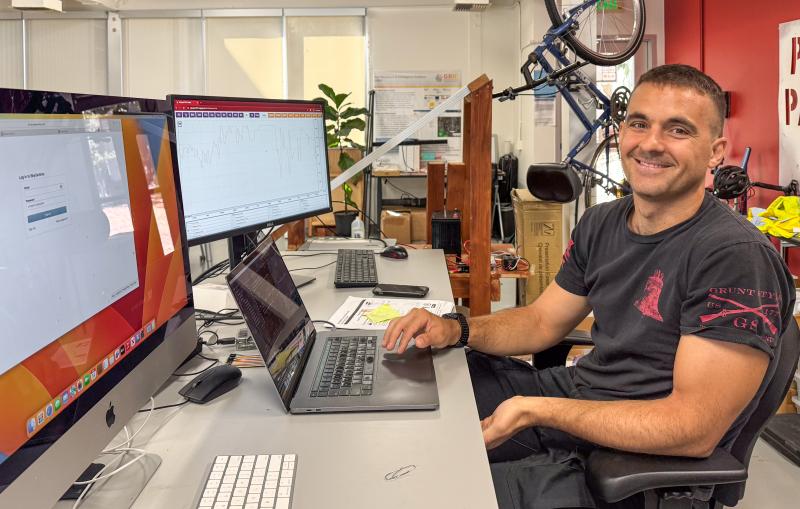
Derek Mendez
SLAC staff scientist
(Olympia Roll/OSO Studios)

Machine learning to catch proteins in action
Proteins are an essential ingredient of life, playing key roles in numerous biological phenomena, such as catalyzing chemical reactions or controlling and coordinating biological processes. They also can help virus molecules invade our cells or shield bacteria from antibiotics.
Developing new drugs to address harmful proteins is a time-consuming process that involves sifting through hundreds or thousands of candidates and testing by trial and error to see which bind to the target protein’s active site.
Derek Mendez aims to speed that discovery process using AI to help optimize X-ray experiments and computer simulations to reveal key information about proteins involved in diseases – information that will feed directly into downstream drug development tools.
He joined SLAC as a project scientist in 2021 after holding a similar position at DOE’s Lawrence Berkeley National Laboratory (Berkeley Lab) where he worked on free-electron laser crystallography and supercomputer applications. Now a staff scientist with the Structural Molecular Biology division at SLAC’s Stanford Synchrotron Radiation Lightsource (SSRL), Mendez is adding AI powered software tools to collect, process and model the complex data gathered from the beamlines and crystallography labs. This work supports crystallographers from around the world who harness SSRL’s bright X-rays to look at the structure and behavior of proteins down to the atomic scale. Using SSRL’s four macromolecular crystallography beamlines, researchers routinely capture single, static “snapshots” of proteins.
However, “proteins are commonly referred to as dynamic molecular machines,” said Mendez. Protein structures can bend or rotate, thus changing how they might bind with other molecules, so it’s critical to understand how they move and change shape.
"That dynamic information is often hidden in the data," said Mendez. "If not, we can run specialized experiments to induce protein movement." He intends to develop software tools that use a machine learning technique called multi-objective Bayesian optimization to extract dynamics information from the crystallography data and paint a fuller picture of protein behavior. He also plans to use AI models trained with simulated data to suggest experimental conditions that will promote observation of protein dynamics or the binding of candidate drugs to a target protein – an approach called AI-assisted experimental steering.
The project will initially focus on proteins involved in antibiotic resistance with the goal of extending the scope to other applications in medicine, bioenergy and biopreparedness for future threats.
“I’m honored to receive this award,” said Mendez. “It will enable me to spend more time investigating critical scientific problems facing the crystallography community as it adapts to new computational and experimental advances, and I look forward to creating a team and combining human and artificial intelligence to tackle hard problems in the study of protein dynamics.”
“Derek’s strong background and experience combine X-ray science and AI to further our understanding of biological molecules,” said Paul McIntyre, associate lab director of SSRL. “This award will allow him to apply his knowledge and skills to create tools for understanding proteins and advancing therapies for treating human diseases and biopreparedness.”
Xueli "Sherry" Zheng
SLAC staff scientist
(Jim Gensheimer/SLAC National Accelerator Laboratory)

Cracking the interface code
Xueli “Sherry” Zheng is passionate about bringing materials science and X-ray science together to solve real-world problems. Her work focuses on improving energy storage for cell phones, laptops and the power grid by studying the electrochemical systems involved.
Zheng joined SLAC as an associate staff scientist at the SLAC-Stanford Battery Center and the Stanford Institute for Materials and Energy Sciences after completing her postdoc at Stanford University. In 2024, she was promoted to staff scientist in recognition of her growing contributions and leadership in advancing research on materials innovation for energy storage systems.
The chemistry in electrochemical systems is complex. With several components – anode, cathode and electrolyte – to consider, researchers need cutting-edge experimental techniques to see the many interactions involved. Zheng will use X-ray techniques, cryogenic electron microscopy and tomography (cryoEM/ET) and machine learning to better understand the chemical processes at the interfaces inside these systems.
“One of the most important factors to influence the system’s performance is the electrode-electrolyte interface,” she said. “Understanding and controlling the chemical dynamics at this interface remains one of the grand challenges in this field.”
Zheng, who is working on sodium-ion systems, proposes to establish a program that will combine machine learning models with state-of-the-art experimental techniques at facilities such as SSRL, Berkeley Lab’s Advanced Light Source and the Stanford-SLAC CryoEM Center.
She will focus her efforts on the cathode-electrolyte interface, where a layer called the cathode-electrolyte interphase, or CEI, plays an important role in battery function and performance. Her vision is to build a model that will predict and guide researchers in designing the optimal CEI to make higher performing sodium-ion systems.
To understand the complex variations in CEI chemistry and structure, the first step involves studying the complex processes happening at the interface through operando X-ray spectroscopy and imaging – experiments conducted under realistic operating conditions – and cryoEM.
The data and observations will provide key insights and help her determine parameters – environmental conditions and materials properties – to regulate and design the optimal CEI. From these two steps, she ultimately wants to build and train a machine learning model that will help researchers steer experiments, thus accelerating progress in designing energy storage systems.
“This award will enable me to initiate the program and advance fundamental studies of interfacial phenomena that I am passionate about to solve this grand challenge,” said Zheng. “The knowledge generated in the program will provide foundational insights that extend beyond sodium-ion systems, informing the design of advanced electrochemical interfaces in a broad range of energy storage systems.”
“At SLAC, we are proud to see Xueli leveraging the unique capabilities of our synchrotron, cryoEM and computational infrastructure to tackle the grand challenge of electrochemical interfaces,” said Christopher Tassone, associate lab director for energy sciences at SLAC. “Her program embodies the collaborative spirit of our lab and exemplifies how we bring world-class tools together to solve problems of national importance.”
SSRL and the Advanced Light Source are DOE Office of Science user facilities. The Stanford-SLAC CryoEM Center is supported by the National Institutes of Health Common Fund Transformative High Resolution Cryo-Electron Microscopy program.
For questions or comments, contact SLAC Strategic Communications & External Affairs at communications@slac.stanford.edu.
About SLAC
SLAC National Accelerator Laboratory explores how the universe works at the biggest, smallest and fastest scales and invents powerful tools used by researchers around the globe. As world leaders in ultrafast science and bold explorers of the physics of the universe, we forge new ground in understanding our origins and building a healthier and more sustainable future. Our discovery and innovation help develop new materials and chemical processes and open unprecedented views of the cosmos and life’s most delicate machinery. Building on more than 60 years of visionary research, we help shape the future by advancing areas such as quantum technology, scientific computing and the development of next-generation accelerators.
SLAC is operated by Stanford University for the U.S. Department of Energy’s Office of Science. The Office of Science is the single largest supporter of basic research in the physical sciences in the United States and is working to address some of the most pressing challenges of our time.
Related stories